
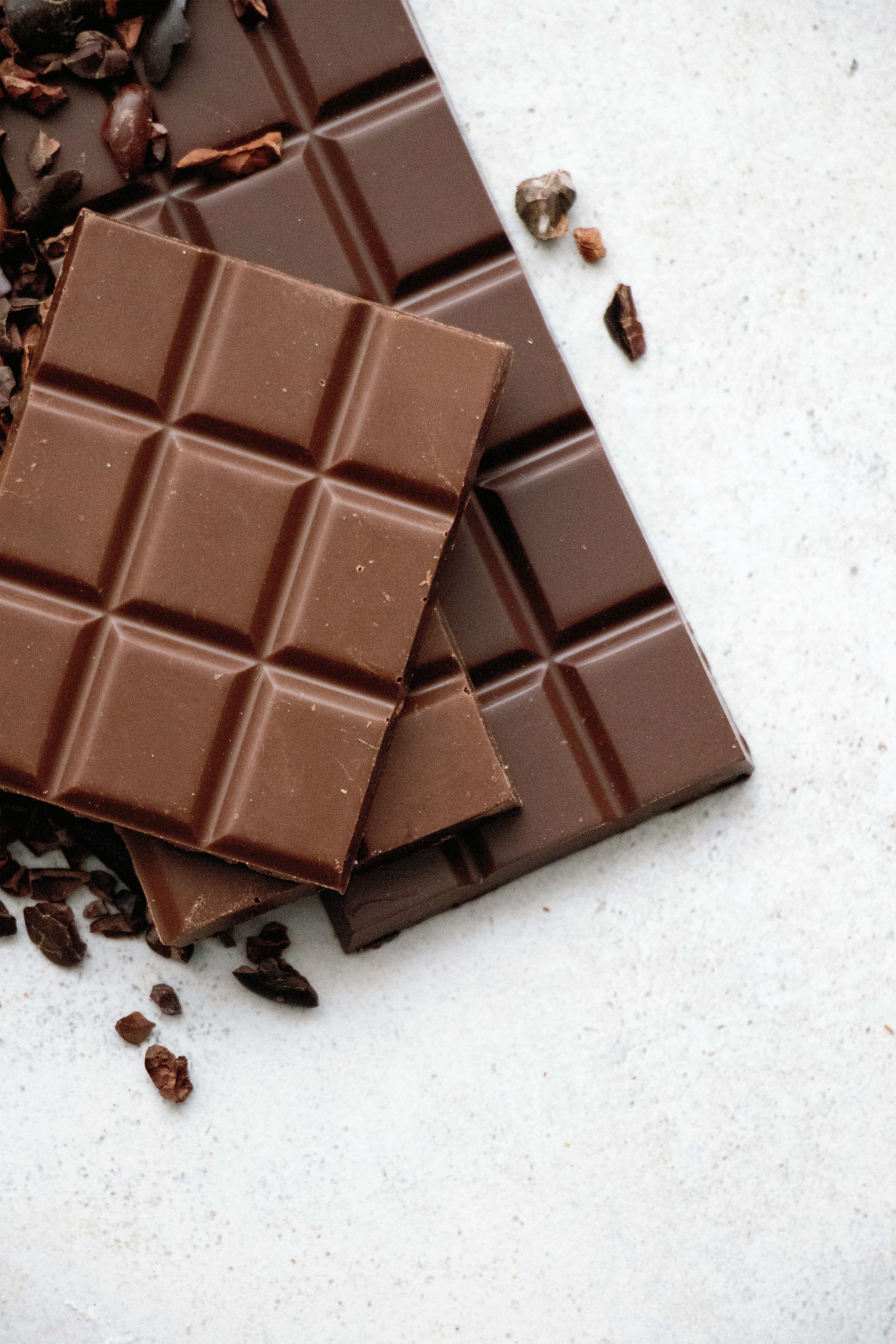
Lactose-Free Chocolate: What You Really Need to Know Before You Bite
When you are lactose intolerant, chocolate is a minefield. Many people assume that dark chocolate is automatically dairy-free. That is wrong in a surprising number of cases, and the confusion comes partly from one simple thing: most consumers do not know what chocolate legally is, nor why so many manufacturers slip dairy products into even their darkest tablets.
This article goes through the question, with some concrete recommendations for Belgium at the end.
My practical recommendations (Belgium)
Before diving into the theory, here is what I personally consume and what I recommend.
For cooking, the Callebaut Callets recipe 811 (54.5% cocoa), found at Colruyt. Callebaut's official ingredient list mentions only cocoa mass, sugar, cocoa butter, soy lecithin and natural vanilla flavor, with no added milk. Be careful, though: the label states "may contain traces of milk" because of shared factory production. For lactose intolerance, these traces are generally inconsequential; for a milk protein allergy, it is a different story (and the product should be avoided in that case).
As tablets, the Galler Dark 70%, Dark 85%, and Dark 70% with cocoa nibs (Carrefour, Delhaize) follow the same logic: no dairy product in the ingredient list, but a "may contain" milk mention due to the production site. A delight, especially the 70% with cocoa nibs whose grué brings a satisfying crunch.
The rule "dark chocolate above 70% equals dairy-free" is too optimistic. It is often true, but not always. The only reliable rule is to read the label every time. Lindt, for example, confirms that only its Excellence 70%, 70% mild, 85%, 85% mild, 90%, and 99% bars contain no dairy products as ingredients. The 78% does contain milk. And even the dairy-free references go through shared production lines and carry the precautionary mention.
In short: cocoa percentage is not a sufficient shortcut. You have to look at the list.
What is chocolate, legally?
In Europe, the composition of chocolate is governed by directive 2000/36/EC of 23 June 2000 relating to cocoa and chocolate products intended for human consumption. It sets minimum thresholds and specifies what can be called "chocolate."
For a product to simply bear the name "chocolate," it must contain at least 35% total cocoa solids, including at least 18% cocoa butter and 14% non-fat cocoa solids.
For the designation "dark chocolate" (sometimes labeled "fine chocolate" or "premium chocolate"), the bar rises to a minimum of 43% cocoa solids, including at least 26% cocoa butter.
The directive also authorizes the addition of vegetable fats other than cocoa butter, up to 5% of the finished product, provided this is clearly indicated on the label. The list of these fats is limitative: illipe, palm oil, sal, shea, kokum gurgi, mango kernel.
The minimum ingredients of a real dark chocolate
If we stick to the essentials, a well-made dark chocolate contains 3 elements:
- Cocoa mass (or liquor), that is, ground cocoa beans, which provide both the aromatic dry matter and part of the fat.
- Cocoa butter, the natural fat of the bean, responsible for the characteristic melt and "snap."
- Sugar, in decreasing quantity as the cocoa percentage rises. and 90% of the times : Lecithin (soy or sunflower), an emulsifier that helps with fluidity and stability.
That is all. A dark chocolate worthy of the name needs nothing else. No milk, no dairy butter, no added lactose, no synthetic flavor. Vanilla, when present, should ideally be real vanilla.
What makes a good chocolate?
The cocoa percentage alone does not say much. Two tablets labeled 70% can taste radically different. Here is what really matters.
Origin and bean selection. Cocoa beans vary by variety, region, terroir, and the mastery of post-harvest fermentation. A poorly fermented or poorly dried bean will always make mediocre chocolate, regardless of the craft applied downstream.
Roasting. Too short, and the aromas do not develop. Too long, and you kill the fruity notes and drift toward burnt. The best chocolatiers adjust their roasting profile by origin.
Conching. This is the prolonged kneading step (sometimes 24, 48, 72 hours) that develops aromas, eliminates undesirable volatile compounds, and gives the chocolate its smooth texture. A rushed conching produces a grainy and acidic chocolate.
The ratio between cocoa butter and non-fat cocoa solids. For the same posted percentage, a chocolate can be very rich in cocoa butter (so fattier, more melting, sometimes sweeter) or richer in dry cocoa (drier on the palate, more intense, more bitter). The two extremes for an 85% give 14% non-fat cocoa solids plus 71% cocoa butter, or 59% non-fat cocoa solids plus 26% cocoa butter. It is the same number on the package, but two completely different products.
The absence of substitute vegetable fats. A chocolate made only with cocoa butter has the legal right to display the mention "pure cocoa butter." This is not just a flourish: replacing part of the cocoa butter with palm oil changes the texture and the taste, and it is almost always done to cut costs.
Freshness and storage. Chocolate ages. The most volatile aromas evaporate, fats can slowly turn rancid. A chocolate bought in a supermarket after several months of storage at variable temperature will never have the quality of a fresh artisan tablet.
Origin of the cocoa and the cadmium issue. Cadmium is a toxic heavy metal naturally present in some soils, which accumulates in cocoa beans. Its concentration depends mainly on geology: the volcanic and alluvial soils of Latin America, particularly in Peru, Ecuador, Colombia, and Bolivia, often contain a great deal of it, sometimes up to several milligrams per kilo in the most loaded regions. The soils of West Africa, where about two-thirds of world cocoa is produced (Ivory Coast, Ghana, Nigeria, Cameroon), generally contain very little. Choosing a chocolate based on cocoa of African origin is therefore a simple way to limit one's exposure to cadmium, especially if one regularly consumes dark chocolate, knowing that cadmium content rises proportionally with cocoa percentage. To be qualified, however: variability is high even within a single country, and all chocolates marketed in Europe must comply with EU regulatory thresholds.
A note on white chocolate
White chocolate deserves separate treatment, because its very definition makes it problematic for the lactose intolerant.
Legally (still under directive 2000/36/EC), a white chocolate is a product obtained from cocoa butter, milk or milk products, and sugars, containing at least 20% cocoa butter and 14% milk solids, of which at least 3.5% milk fat. Note the central point: unlike dark chocolate, milk is not an option, it is an obligation. Without milk, a product cannot bear the name "white chocolate" in the European Union.
The typical composition of a white chocolate tablet hovers around 20 to 40% cocoa butter, 20 to 25% milk powder, and 40 to 50% sugar, plus an emulsifier and sometimes vanilla. No cocoa mass: that is what explains the ivory color and the absence of bitterness, but also why some purists consider that white chocolate is not really chocolate. For European bureaucrats, it is. For the palate, it is above all sweetened-milk-flavored vegetable fat.
Why it is almost impossible to find a traditional lactose-free white chocolate. Because the minimum 14% milk solids required by law are not a decorative additive: they are what gives white chocolate its structure, its creaminess, and its taste. Removing them amounts to changing the product. A manufacturer therefore cannot make a "lactose-reduced" white chocolate while staying within the legal designation.
A few options nonetheless exist for intolerant enthusiasts. The first: white chocolates based on lactose-free milk. A few specialized manufacturers offer them, using a milk in which lactose has been enzymatically hydrolyzed. These products are rare and rather expensive, but they respect the legal designation and suit the intolerant. The second option, more common in recent years: vegetable alternatives, labeled "vegan white chocolate" or "white chocolate alternative." They replace milk powder with plant-based milk powder (rice, coconut, almond) or with rice powder directly. Legally, they cannot be called "white chocolate" in the strict sense of the directive, which is why we often see workaround formulations like "white chocolate alternative," "white inspiration," or simply the vegan mention. Taste-wise, it is decent but different: the coconut or rice note is generally perceptible.
If you really want your white chocolate fix, the vegan aisle or the allergen-specialized shops are what you should aim for, not the classic chocolate aisle of the supermarket.
Why do manufacturers add dairy products, even in dark chocolate?
This is the real question. If the canonical recipe of dark chocolate does not need milk, why do we find it so often in ingredient lists, even in tablets advertised as "intense dark" or "dark 70%"?
Several reasons coexist.
Softening bitterness at low cost. Cocoa alone, especially above 70%, can be perceived as too bitter or too dry by some consumers. Milk powder, concentrated dairy butter, or lactose add roundness and softness without having to upgrade the cocoa quality. It is an industrial patch that allows a "70%" chocolate to be sold to a wider audience, without investing in better-fermented beans or longer conching.
Improving texture. Dairy butter modifies fat crystallization and can give a creamier mouthfeel. For a manufacturer who does not want (or does not know how) to perfectly master the tempering of cocoa butter, it is a shortcut.
Reducing the amount of cocoa butter. Cocoa butter is the expensive ingredient of chocolate. Partially replacing it with dairy butter or with the authorized vegetable fats (up to 5%) lowers the cost. The consumer does not see it in the posted percentage, because the cocoa percentage is calculated on total dry matter, not on fat quality.
Production in mixed factories. Many chocolate makers produce both dark and milk on the same lines. When milk is intentionally used in some batches, it becomes economically simpler to allow it in other recipes than to reorganize production.
Consumer habits. In some markets, particularly North America and the United Kingdom, the palate is used to a sweeter and milkier chocolate. Local recipes have been adapted accordingly, and even a chocolate marketed as "dark" can contain milk.
To remember: the presence of milk in a dark chocolate is almost always an industrial formulation choice, not a technical necessity.
Lactose, traces, and labeling: the nuance that matters
For someone following Lactose.help, the distinction is crucial.
Lactose as an ingredient appears clearly in the list: "lactose," "milk powder," "skimmed milk powder," "concentrated dairy butter," "whey," "milk serum," "caseinate," sometimes more discreetly as "butyric fat." A chocolate containing these ingredients contains lactose in significant quantity and is not suited to intolerance.
The mention "may contain traces of milk" is a precaution linked to shared factory production. Quantities are generally very low (well under one gram per 100g, often below the detection threshold), but the mention remains mandatory for consumers allergic to milk proteins, where a trace can be enough to trigger a reaction.
This is where the mission of Lactose.help makes full sense: for lactose intolerance (lactase deficiency, hence a question of quantity), a "pure cocoa" dark chocolate with a trace mention is generally perfectly tolerable and logically receives a good Lacto-Score. For a milk protein allergy (an immune reaction that can be triggered by micro-quantities), the same tablet should be avoided.
If you are lactose intolerant, the strategy is simple: aim for a dark chocolate whose ingredient list mentions no dairy derivative, and in principle ignore the trace mention. If you are allergic to milk proteins, then you have to look for chocolates produced on dedicated lines, which drastically reduces the choice.
In practice: how to choose a tablet
Three reflexes to adopt in store:
First, turn the tablet over and read the complete ingredient list. If you see "milk," "lactose," "dairy butter," "whey" or any derivative, move on. If you see only cocoa, cocoa butter, sugar, and lecithin, that is a good sign.
Then, look for the "pure cocoa butter" mention if you care about a chocolate without substitute vegetable fats. Its absence does not disqualify the product, but its presence is a sign of fidelity to the raw material.
Finally, do not blindly trust the cocoa percentage. A poorly worked 70% will be less pleasant than a 60% from a serious chocolatier. And a 70% may very well contain milk: it is not the percentage that excludes dairy products, it is the recipe.
To save you from having to dissect every label in store, we developed the Lactose.help mobile application. By scanning a product's barcode, it gives you the maximum level of lactose risk to expect, classified on the A to E Lacto-Score. The analysis cross-references the official ingredient list, known dairy derivatives, and the estimated content. This is exactly the reflex to adopt when faced with a tablet you are not sure about: one scan, and you know whether you can bite with confidence.
Lactose-free chocolate exists in abundance, you just have to know where to look. And the more you know what is in a tablet, the more you appreciate the taste.
Photo by Tetiana Bykovets on Unsplash