
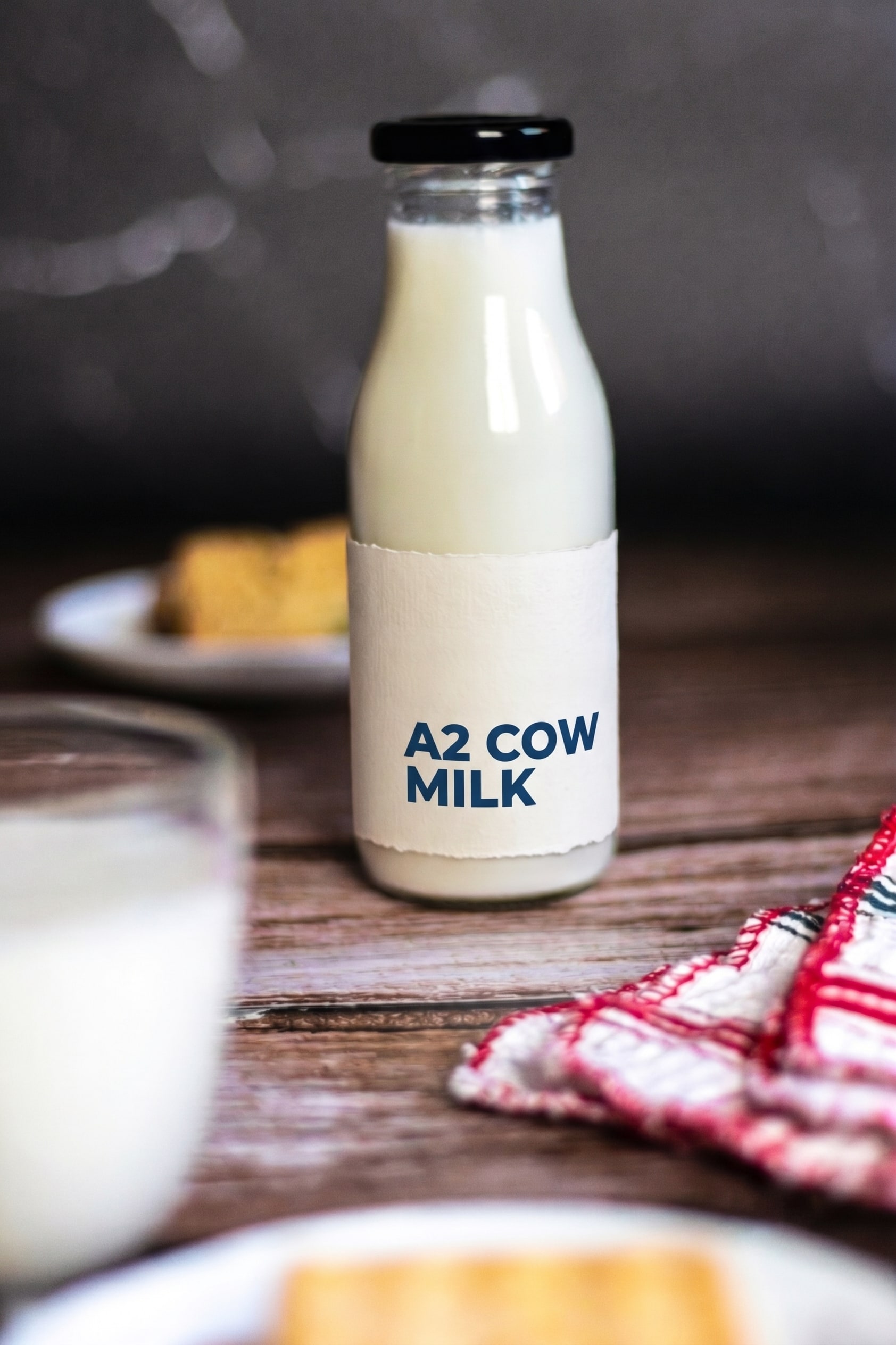
A2 Milk and Lactose Intolerance: What Science Actually Says (and What the Marketing Leaves Out)
You've probably spotted those A2 milk bottles in the dairy aisle. Maybe someone told you: "Try A2 milk, it's easier on the stomach." Maybe you tried it and it actually worked.
But do you know what it actually is? And more importantly, whether it's right for your situation?
Let me explain.
What is A2 milk, exactly?
Cow's milk contains proteins. Among them, beta-casein, which comes in two main variants: A1 and A2.
The milk you usually buy? It's a blend of both. A2 milk comes from cows bred to produce only the A2 variant.
And here's the crucial point that marketing tends to gloss over: A2 milk contains exactly the same amount of lactose as regular milk.
Exactly the same.
It's not lactose-free. It's not "lighter" in any way. The only thing that changes is the protein.
So why do people claim they digest it better?
The BCM-7 trail: when protein plays the troublemaker
This is where it gets fascinating.
When your body digests A1 protein, it releases a small peptide called BCM-7 (beta-casomorphin 7). And this peptide is involved in gut inflammation. It slows transit. It causes bloating, cramping, gas.
Symptoms we often blame on lactose... that might actually come from the A1 protein.
Several clinical trials support this. In Chinese adults reporting milk intolerance, A2 milk significantly reduced digestive symptoms compared to regular milk (He et al., 2017; Sun et al., 2015). Crossover trials in intolerant adults confirm it: less abdominal pain, less gas, and even reduced intestinal fermentation with A2 milk (Ramakrishnan et al., 2020, 2024). The same pattern shows up in intolerant women (Milan et al., 2019) and preschool children (Sheng et al., 2019).
Biological markers follow the trend: reduction in fecal calprotectin (a gut inflammation marker) and pro-inflammatory cytokines when switching to A2 milk (Ramakrishnan et al., 2023; Choi et al., 2024).
Pretty compelling.
But wait. Before you toss your lactose-free milk, there are important caveats.
The limitations marketing doesn't highlight
First caveat: lactose is still there. If you have clinically confirmed lactose intolerance (via a hydrogen breath test, for instance), your issue is lactose, not protein. And in that case, lactose-free milk generally remains better tolerated than A2 milk (Ramakrishnan et al., 2020; Mannila et al., 2025; Sharp et al., 2021).
Second caveat: when lactose is removed from the equation, some trials find no difference between A2 milk and regular milk (Robinson et al., 2025; Mannila et al., 2025; Greenway et al., 2026). This suggests that for some people, lactose is indeed the problem, and the protein type is irrelevant.
Third caveat: funding. Several of the most cited A2 milk studies were funded by the A2 industry or dairy sector players (Ramakrishnan et al., 2020, 2024; Pal et al., 2015). This doesn't mean the results are wrong. But it means they deserve a critical reading.
So which milk should you choose?
Here's the summary:
Regular milk (A1/A2 + lactose) is the most likely to trigger symptoms in sensitive individuals.
A2 milk (A2 only, but with lactose) reduces symptoms for many people, likely by eliminating BCM-7. But it doesn't always eliminate them completely.
Lactose-free milk (A1/A2, no lactose) is often even better tolerated by true lactose-intolerant individuals.
Lactose-free milk with hydrolyzed proteins is the best-tolerated option in trials, even for the most sensitive people (Mannila et al., 2025).
In practice? If regular milk bothers you, try A2 milk. If symptoms persist, switch to lactose-free. And if you want certainty, get a lactose malabsorption test to find out whether your issue is the sugar or the protein.
The bottom line
A2 milk isn't a scam. But it's not the miracle solution the marketing wants you to believe either. It's a tool, useful for a specific category of people: those whose discomfort comes from the A1 protein, not from lactose.
The problem is that most people don't know which side they're on. And A2 milk marketing has no incentive to help them figure it out.
Stay curious. Read the labels. And above all, listen to your gut.
And you, what do you think? Have you tried A2 milk? I'll see you very soon for another adventure!
Sources: He et al. (2017), Sun et al. (2015), Ramakrishnan et al. (2020, 2023, 2024), Milan et al. (2019), Sheng et al. (2019), Pal et al. (2015), Choi et al. (2024), Jeong et al. (2023), Mannila et al. (2025), Robinson et al. (2025), Greenway et al. (2026), Sharp et al. (2021).
Photo by VD Photography on Unsplash