
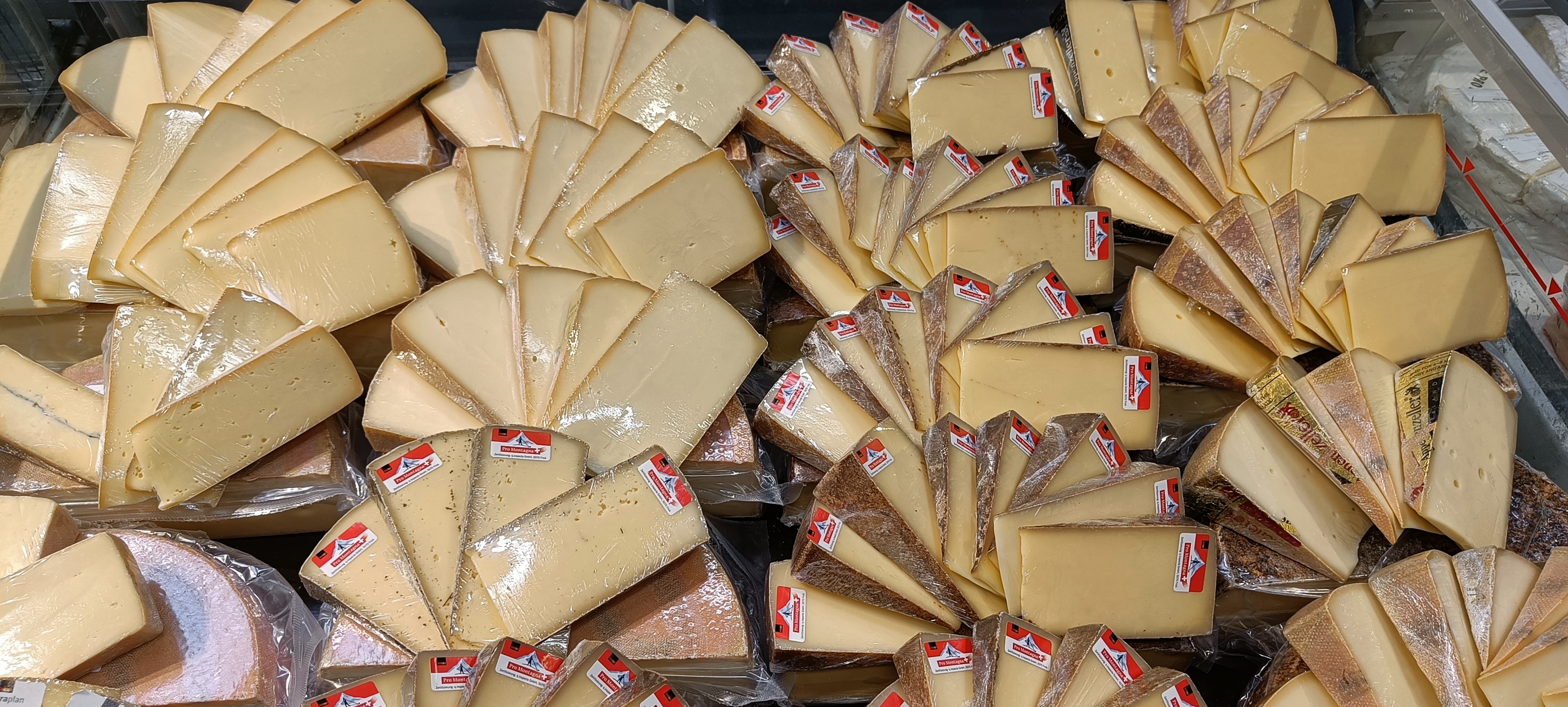
Lactose free cheese
Lactose-Free Cheese
On supermarket shelves, you'll find cheese labelled "lactose-free." But here's a question few people think to ask: what if regular cheeses, with no mention of it on the packaging, were also perfectly compatible with lactose intolerance?
In artisanal and protected designation of origin cheeses, there are normally only four ingredients: milk, rennet, salt, and cultures. The only source of sugar is the lactose from the milk. And since lactose is a simple sugar, it appears in the "of which sugars" line of the nutrition table, giving you the maximum lactose concentration of the product directly.
How much can you tolerate? According to an EFSA study, people with lactose intolerance can generally consume between 6 and 12g per day, spread across three meals. The most sensitive individuals experience symptoms from as little as 3g. But a dose of 1g per meal is compatible with all forms of intolerance.
And what does 1g of lactose actually look like in practice? 76% of protected designation of origin cheeses in the European Union show a maximum concentration of 0.5g per 100g. In other words, you can eat 200g before even reaching that threshold. The complete list of these designations is available in the book Living Better with Lactose Intolerance: The Practical Guide to Understanding, Reintroducing, and Enjoying Dairy Products, at book.lactose.help.
To go further, we developed lactose.help, an app that lets you scan a product in-store and get its risk level in the form of a Lacto-Score — the equivalent of the Nutri-Score, but applied to lactose concentration:
- A - Safe: 0g per 100g. Lactose-free, suitable for everyone.
- B - Generally Safe: ≤0.5g per 100g. Tolerated in the vast majority of cases.
- C - Caution: ≤1g per 100g. To be consumed in moderation.
- D - Risky: ≤1.5g per 100g. Likely to cause symptoms.
- E - High Risk: >1.5g per 100g. To be avoided if intolerant.
- Product not found: not in our database; manual ingredient analysis will be required.
The idea, at its core, is simple: buy regular, quality products, at no extra cost, with the assurance of not feeling ill. Raclette, tartiflette, mont d'or, fondue — all these dishes you had set aside are entirely possible, even with lactose intolerance.