
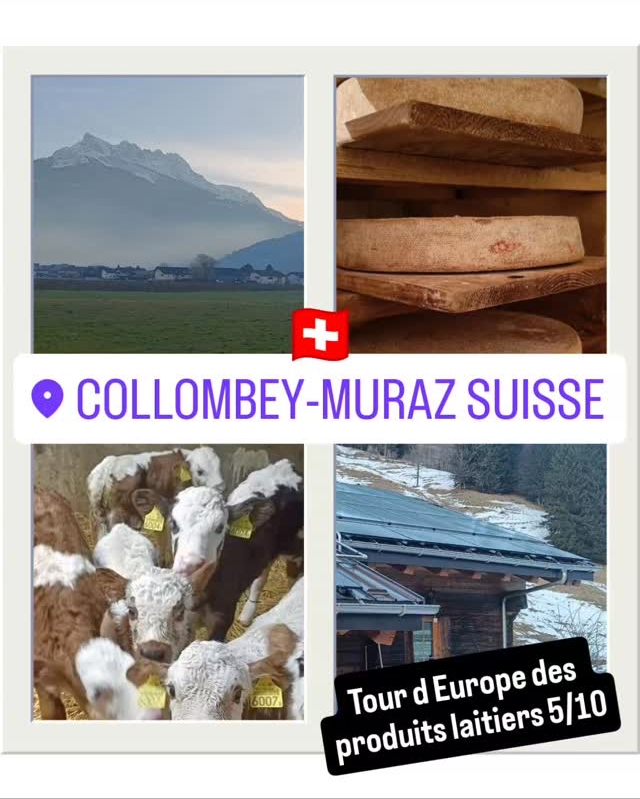
European Dairy Tour - Stop 5: Collombey 🇨🇭
Welcome to this new series of articles where I take you across Europe to explore dairy products, lactose-free options, and vegan alternatives. As someone who is lactose intolerant and co-founder of the lactose.help app, I decided to travel across the continent, app in hand, to give you a concrete overview of what awaits you if you're travelling with an intolerance.
Fifth stop (2 days): Monthey, in the Swiss Valais. I wanted to have a rest day in the middle of the journey to recuperate a bit and have a safety margin in case I missed a stage, so as not to lose all my reservations for the rest of the trip.
And this time, a big surprise: an immersion in a real dairy farm where they produce, in addition to milk, Raclette du Valais AOP!
The Journey: Make or Break
The train left Florence, a perfect journey to Bologna. Unfortunately, we got stuck there with an expected delay of 19 minutes. However, I only have 15 minutes to change trains in Milan...
To be continued. I've already had scares during previous days and in the end, the trains managed to make up the delay. Or I just have to hope that the next one is delayed too.
The only catch today: I have 4 consecutive trains. It's going to be challenging. The good news is that I'm supposed to arrive around 2-3 PM, so I have some margin if I need to take the next train. Anyway, no room for stress, I'm not in control of anything.
I was absorbed in writing on the train when I heard I needed to get off in two minutes. All hands on deck, I packed everything up and hopped onto the next train. I only have 10 minutes to change trains. A loaded sprint between platforms 17 and 4 in rugby player mode. Anyway, I didn't miss my train.
Don't count on electricity or wifi on trains, it's too random from one train to another. Yesterday for example, they changed the train model for an unknown reason, my seat had to be converted to figure out where I should sit.
The Pleasant Surprise: Immersion at the Gex-Fabry Farm
I'm visiting Alexis Gex-Fabry, who has 55 dairy cows on his Valais farm. Alexis is passionate about his work and his region.
The Gex-Fabry farm is based in Valais, with a dairy operation in Collombey, an alpine pasture above Champéry, and the cheese dairy between the two. The farm has been operated for about seven generations, anchoring the agricultural activity in a long family tradition.
To discover the farm on video:
Boundless energy! I arrived in the late afternoon. After chatting a bit, I accompanied him for the evening milking. I helped clean the stall, prepare their food in the "manger," bring in the cows, let them eat, prepare the milking machines both for the small off-season production and to feed the calves. Once the milking machine is connected, Alexis moves to the next cow after a little scratch. It's quite a job but fortunately greatly facilitated by automatic milking machines. The milk for the calves is put in a small bucket with a teat from which they feed.
Many people came to pick up raw milk and cheese. Alexis produces Valais alpine raclette cheese, meaning only in summer.
Locals of various origins come to get raw milk to recreate dairy products from their home countries.
He explained to me that raw milk contains more than 800 different bacteria, some of which naturally produce lactase!
The Life of a Mountain Farmer
They have their farm in the valley, a building in the alpine pasture (nearly 1,950 m altitude), and the cheese dairy they recently renovated with guest rooms above.
Here, you need to be not only a farmer to produce the hay the cows need, but also very resourceful to repair various machines, renovate buildings... Each operation has its machines, its ways of doing things, so everything depends solely on them. Alexis has incredible energy and every movement in his barn is precisely calculated.
They have 5 children on top of that!
Why No Cheese in Winter?
They don't produce cheese in winter for several reasons. Since the cheese dairy is at altitude, it's difficult to access in winter. Moreover, there's already so much cheese produced during this season. Finally, it allows the cows to take a calmer pace to be at their best for the alpine season, between late June and early October.
Each cow produces an amount of milk depending on its lactation cycle, generally between 4 and 15 litres per milking. They can live up to 25 years! After 2 years as heifers, they can give birth to a calf each year. The cows are taken to the alpine pastures in the warm season; they must be robust to move around in rough terrain. Each one has a bell, and Alexis can recognise each animal by its sound. They apparently sense his emotions. He actually finishes each milking with music.
Making Raclette du Valais AOP
Valais raclette cheese is produced according to strict specifications. Here are the main steps:
The milk: the cows are fed 75% fodder produced in the region. The milk must be cooled immediately after milking and processed within 24 hours.
Ripening and curdling: production must be done in copper vats (5,000 litres max). The milk is heated to 32°C with specific lactic cultures. Alexis monitors the activity using his pH meter. Once optimal activity is reached, he adds natural animal rennet from calf stomach, which curdles the milk.
Working the curd: the curd is cut into small pieces the size of a small pea, then stirred. 10 to 15% water is added to wash the grain (this is the delactosing!). The mixture is heated between 36 and 45°C.
Moulding and pressing: the curd is placed in round moulds and pressed for a minimum of 4 hours (50 kg of pressure). The whey is completely expelled along with the lactose. It's during turning that the traceability mark is applied and the cheese dairy's name is stamped into the heel.
Salting: the cheese is immersed in a brine bath for 22 to 24 hours.
Ageing: the wheels are aged in cellars on rough red spruce wood boards for a minimum of 3 months (up to 12 months for the "à rebibes" variety). The cheeses are regularly turned and rubbed to develop the morge, that characteristic brown-orange rind.
Once his cheeses are ready, Alexis brings them to a cooperative that has a cellar with a robot where several producers come to deposit their production. Christine and he sell part of the production locally.
The raclette cheese within 6 months. Here, it's early January, it's the end of the stocks.
An Eco-Responsible Cheese Dairy
The cheese dairy is supplied with hot water by thermal panels and electricity by photovoltaic panels. The cooling required for one stage of production is provided by a spring where the water is very cool all year round. The backup heating if there's no sun is provided by a wood-fired boiler.
Last year, Alexis produced 22 tonnes of Valais raclette cheese (Dents du Midi 30). All in conditions minimising environmental impact. I find it quite fabulous to eat a quality product made with respect for nature. The whey is partly used to feed pigs during the warm season.
The cheese dairy project came about following the realisation that the milk price was too low and that it needed to be valued differently. Their milk is currently bought back too cheaply to live on. With the help of a Regional Development Project, the project became a reality in 2018.
Prestigious awards:
- World Raclette Championships 2023: 1st place in the "dairy cheese, raw milk" category for Le Pont cheese dairy.
- Fromage & Cime Competition 2025: "Fromage & Cime Silver" for the Pont-sur-Champéry alpine pasture, Alexis Gex-Fabry Family.
Ski Touring and Alpine Discovery
After inventorying dairy products in the morning at the town's supermarkets, Alexis joined me to take me ski touring to visit the cheese dairy (at 1,389 m altitude) and the alpine chalet (at 1,851 m altitude) that he has both renovated in recent years. We leave from a small car park a few hundred metres below the cheese dairy. The snow is crusted or icy.
The ski touring outing is no walk in the park. You can tell Alexis has a physical job with good cardio, especially as he's a former marathon runner. I hope I can keep up.
On the floor above the cheese dairy, he created a gîte to welcome tourists in summer. In winter, the cheese dairy is too far from the alpine ski slopes but remains accessible by ski touring with a bit of perseverance.
We continued climbing to reach the alpine pasture, just opposite one of the famous black runs known to be one of the steepest and most difficult descents in the world at 37°: the Swiss Wall, in the Portes du Soleil resort.
At the alpine pasture, in addition to the shelter for the cows, there's a shelter for pigs. And the view is simply magical.
We then descended to pass by the Cavagne, the cooperative where their cheeses are aged, before going back down to the farm to tend to the cows before dinner. A fondue is on the menu!
Fondue: The Perfect Meal for the Intolerant If Chosen Well!
We share a good fondue with a local wine, Johannisberg, which I personally find better than Fendant. I also learned that locals eat raclette and fondue all year round, summer and winter!
Fondue recipe for four people:
| Quantity | Ingredients |
|---|---|
| 500 g | bread, cut into small cubes |
| 500 g | raclette potatoes, jacket potatoes, kept warm |
| 1-2 | garlic clove(s), sliced |
| 400 g | Vacherin Fribourgeois AOP, grated (lactose concentration B) |
| 400 g | Gruyère AOP, grated (lactose concentration A) |
| 4 tsp | flour or cornstarch |
| 4 dl | white wine |
| 1 small glass | kirsch, non-alcoholic cider, or apple juice |
| pepper |
Preparation:
- Rub the caquelon with garlic.
- Mix the cheese and cornstarch. Bring to a boil with the wine over medium heat, stirring constantly until you obtain a smooth consistency. The fondue should no longer boil.
- Add the kirsch, season with pepper.
- Keep warm on the burner over medium heat. Spear the croutons and potatoes on fondue forks and dip them in the mixture.
And watch out, whoever drops their bread in the cheese gets a forfeit! Bon appétit.
Now, the Results of My Research, but First a Quick Reminder of the Method
For those just joining us, lactose.help classifies products according to their maximum lactose risk, from A (very low risk, worry-free consumption) to E (high risk, to be avoided). You can consult the complete methodology here.
Supermarket Mission: Migros, Coop, Aldi, Manor, Kiss the Ground
I toured most of the town's supermarkets to add as many Swiss appellation cheeses as possible to the Open Food Facts database. My list in the book being a bit short on this subject due to lack of data, I'll be able to fill in the gaps.
I should have counted the number of metres of cheese aisle shelving. It's counted in dozens: Swiss, French, Spanish, Italian, English cheeses and, more surprisingly, a choice of Balkan cheeses and other less obvious regions.
Few cheeses are on Open Food Facts but at least I'll have plenty of data to add.
Lactose-Free Ranges
In the large supermarkets, I found wide ranges of lactose-free products: butter, milk, cream, sour cream, etc. There's no shortage of choice.
Swiss Cheeses: Paradise for the Intolerant
The list of cheeses in A and B is impressive!
Lactose concentration A (Safe, maximum 0.1 g/ 100g):
- Gruyère AOP
- Etivaz AOP
- Tête de Moine AOP
- Sbrinz AOP
- Appenzeller AOP
- Raclette du Valais AOP
- Le Dzûyo
- Le Sapalet (sheep's cheese)
- Le Bleu de Gruyère
- Blochon de la Venoge
- La Tomme vaudoise
- Aletsch
- Mont-Soleil
- Vollfett-Halbhartkäse
- La Chèvre d'Or
Lactose concentration B (Generally Safe, maximum 0.5 g/ 100g):
- Emmental AOP
- Vacherin Fribourgeois AOP
- Formaggio d'Alpe Ticinese AOP
- Vacherin Mont d'Or AOP
- Fondue Vacherin Fribourgeois and Gruyère AOP
- Schafkäsli
Lactose concentration E (High Risk, minimum 1,5 g/ 100g):
- Sérac Nature (whey-based cheese)
The choice of Swiss cheeses at Aldi is more from the German-speaking region of Switzerland.
I had an overwhelming majority of cheeses in A, a few cheeses in B which are still perfectly consumable without symptoms by the intolerant in a reasonable quantity.
Unfortunately, packaged cheeses in large stores are often those from the region and don't always have nutritional composition, the "of which sugars" information is missing, or the ingredients list. Without this information, it's impossible to know except with laboratory analysis.
Conclusion
Nothing like ski touring for a deep sleep.
This Swiss stop was exceptional, well beyond simple product analysis in supermarkets. Discovering the work of a passionate mountain farmer, understanding the making of an AOP cheese from start to finish, and seeing that almost all Swiss cheeses are in A or B... it's paradise for the lactose intolerant!
Switzerland proves that quality cheese is often low in lactose. No need to look for "lactose-free" products in the specialised aisle: head straight for traditional cheeses.
Choosing AOP also means choosing unique know-how, with quality products, far from ultra-processed products. It also means supporting passionate people like Alexis who work tirelessly to produce these wonders in the most environmentally friendly conditions.
Join me tomorrow for the next stop on my European dairy tour: Avignon!
And you, have you ever travelled to Switzerland with lactose intolerance? Share your experiences in the comments!
None of the brands or stores mentioned are involved in a partnership. If they were, it would be clearly stated.
To Go Further
I wrote the practical guide Living Better with Lactose Intolerance: The Practical Guide to Understanding, Reintroducing, and Enjoying Dairy Products, available at book.lactose.help. For now, the book is only available in French, but you can vote for your language at lactose.help/book. We will translate the book based on the votes received.