
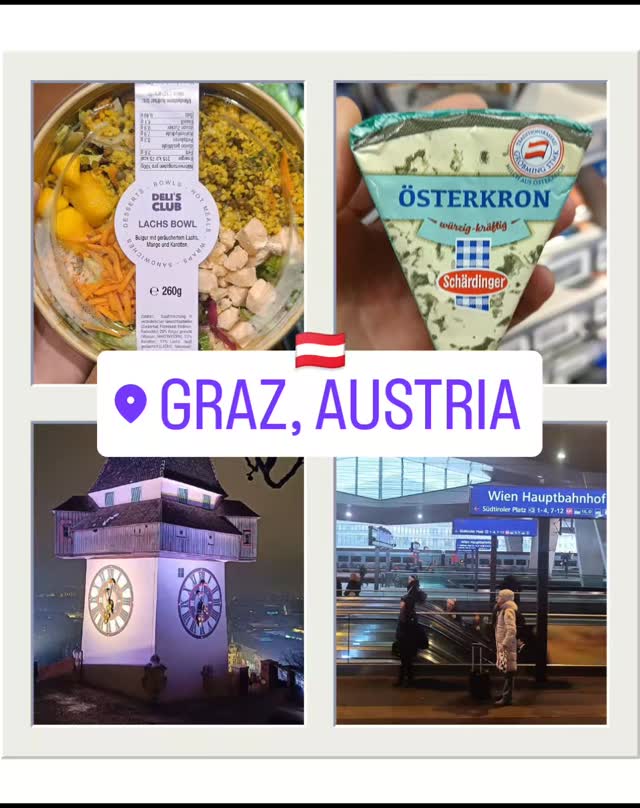
European Dairy Tour - Stop 3: Graz 🇦🇹
Welcome to this new series of articles where I take you across Europe to explore the dairy products, lactose-free options, and vegan alternatives available. As someone with lactose intolerance and co-founder of the lactose.help app, I decided to travel across the continent, app in hand, to give you a concrete overview of what to expect if you're travelling with an intolerance.
Third stop: Graz.
The journey: a turbulent railway adventure
Today's menu: two trains with ÖBB. The first from Prague to Vienna, followed by a second from Vienna to Graz.
On the train, a food and drink trolley comes by regularly. But apart from nuts, peanuts, and certain beverages, I wouldn't risk it.
In Vienna, I normally have 20 minutes to find something to eat before my connection. Except I discover the train is showing a 50-minute delay. I take the opportunity to dash to Spar to buy my lunch and scan a few products. First good impression: plenty of lactose-free products — butter, milk, cream, sour cream, buttermilk, yoghurt, dairy drinks. Nice to see.
I check the screens again: the delay has now increased to 1h30. Perfect, I have time to explore a second shop five minutes away on foot. I grab a trolley, drop my heavy bags in it, and off I go. Great selection of lactose-free products, lots of diverse cheeses, similar to Munich but with local specialities.
I leave the shop with 20 minutes to spare before the announced time. Good thing I did: I notice with horror that they've moved the train forward compared to the previously displayed delay. Fortunately, I just made it. I finally arrive in Graz 1h20 late.
In Graz, I take advantage of a larger Spar to continue my analyses. There's almost nothing but Spar shops in this city. The harvest was good: a large number of local products to scan.
I drop off my luggage at the Airbnb then head back out to other supermarkets to expand my data. I had a bit of a scare with this delay: all my accommodation bookings are grouped in five-day blocks and the trains are fixed. Missing a stage would have put me in trouble for several days.
Quick reminder on the method
For those just joining us, lactose.help classifies products according to their maximum lactose risk, from A (very low risk, safe consumption) to E (high risk, avoid). You can check out the full methodology here.
Austrian PDO cheeses to find
Before leaving, I had listed the Austrian PDO cheeses I wanted to try to find:
- Ennstaler Steirerkas
- Gailtaler Almkäse
- Tiroler Almkäse / Tiroler Alpkäse
- Tiroler Bergkäse
- Tiroler Graukäse
- Vorarlberger Alpkäse
- Vorarlberger Bergkäse
Supermarket mission: Spar and Billa
The number of references in the Open Food Facts database is better than in the Czech Republic, but still not as comprehensive as in France. The AI mode in lactose.help was very useful once again. However, when the network is poor in a shop, it's a struggle — not just for lactose.help, but for any app that doesn't have an offline mode.
Lactose-free ranges
At Spar, the "Free From" range offers Philadelphia-style cream cheese, buttermilk, dairy drinks, and coffee with milk — all lactose-free.
At Billa, their lactose-free range includes Philadelphia-style cream cheese, Schlagobers (36% whipping cream), Sauerrahm (sour cream), yoghurt, and butter.
As in Germany, finding lunch was no problem: vegetarian and vegan products are very widespread.
Local cheeses: a great discovery
Lactose concentration A (Safe, maximum 0.1 g / 100 g) :
- Österkron: cheese typical of the Austrian alpine cheese-making tradition.
- Almkönig: typically Austrian cheese, even without PDO/PGI certification.
- Jausenkäse: an Austrian classic.
- Mondseer: one of the most traditional and popular Austrian cheeses, often compared to Limburger or Munster for its strong character.
- Kräuterschatz Alma: Austrian herb cheese.
- Bergkäse: traditional Austrian/alpine pressed cooked cheese, similar to Gruyère or Comté, produced in mountainous regions. Vorarlberger Bergkäse is the PDO version, with no more lactose.
- Berg Bauer Kellergold: cheese from hay-fed cows.
- Tilsiter: a cheese of Swiss/German origin, but produced here in Austria.
- Tiroler: cheese typical of the Tyrol region.
- Graukäse (grey cheese): a very typical speciality from Austrian Tyrol and South Tyrol in Italy.
- Moosbacher: another great Austrian discovery.
Lactose concentration B (Generally Safe, maximum 0.5 g / 100 g) :
- Hessischer Handkäse: a curiosity! It's a traditional German sour milk cheese from the Hesse region, usually small, round, and often served "mit Musik" (with onions and vinaigrette). I didn't expect to find it in Austria.
- Steirerkäse: traditional fresh cheese from Styria (Steiermark), the region in south-eastern Austria where Graz is located.
Restaurant side
At lunchtime, I easily found a lactose-free salad. Everything is very well labelled here. It was a bit too green for my taste, but that's probably just me.
In the evening, tired from carrying my gear all day, I ended up going to McDonald's to buy some chicken nuggets. They're lactose-free, cheap, quick, and warm. Given my level of fatigue, it was more than appropriate.
After a good night's sleep, I opted for a minimalist breakfast: a juice and two pretzels for the train, not knowing when I'd be able to get more food.
Conclusion
This Austrian stage was easy. No hassle, except for the train delay — but no consequences thanks to my safety margin. The allergen list was available at all points of sale or, at worst, on their website. Austria, like Germany, has many vegans, so for those looking for substitute products, you'll be well served.
And above all, remember this: the vast majority of Austrian cheeses are rated A, B at worst. As someone with lactose intolerance, there's no reason to deprive yourself. Cheese remains your friend.
The difference between Austria and the Czech Republic is striking, both in terms of cheese variety and consumption habits. Czechs use quite different dairy products from their alpine neighbours.
I have no doubt that Italy will have other types of cheeses in store for me to discover.
Join me tomorrow for the next stage of my European dairy tour: Florence!
Have you ever travelled to Austria with lactose intolerance? Share your experiences in the comments!
None of the brands or shops mentioned are involved in any partnership. If that were the case, it would be clearly stated.
To go further
I wrote the practical guide Mieux vivre avec son intolérance au lactose: Le guide pratique pour comprendre, réintroduire et savourer les produits laitiers (Living Better with Lactose Intolerance: The Practical Guide to Understanding, Reintroducing, and Enjoying Dairy Products), available at book.lactose.help. For now, the book is only available in French, but you can vote for your language at lactose.help/book. We will translate the book based on the votes received.