
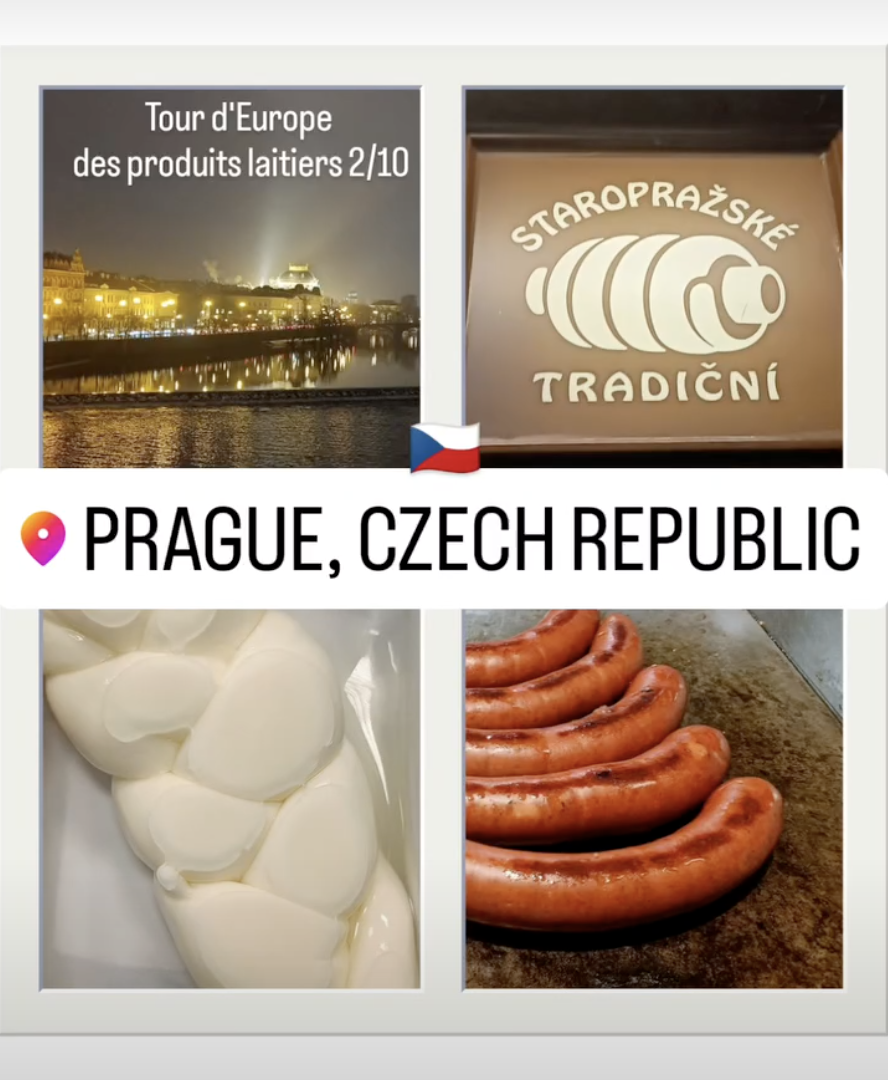
European Dairy Tour - Stop 2: Prague 🇨🇿
Prague: Discovering Central European Dairy Products
After a peaceful journey through the countryside and forests between Munich and Prague, here I am in the Czech capital, scanner in hand, ready to explore the local dairy offerings.
A Quick Reminder About the Method
For those just joining us, lactose.help classifies products according to their maximum lactose risk, from A (very low risk, worry-free consumption) to E (high risk, avoid). You can check out the full methodology here.
The Journey: Self-Sufficiency Required
On the train, a food trolley came by regularly. But after the Munich experience, I didn't have the courage to try my luck. Fortunately, I'd planned ahead: two plain pretzels in my bag got me through until arrival.
A Stark Contrast with Germany
The change from Munich is quite dramatic. There, most scanned products were already in the Open Food Facts database. Here in Prague, not only do I not speak Czech—nor German for that matter—but few products are listed.
When developing lactose.help, we anticipated this situation. The app then prompts you to take two photos: the ingredient list and the nutrition table. Once these images are sent to the AI engine, the answer comes back in seconds.
I can confirm that this mode is particularly useful, not only at home but especially when traveling and you don't know the local language.
Exploring the Albert Supermarket
Lactose-Free Products: A Pleasant Surprise
I was pleasantly surprised to discover a wide range of lactose-free products (bez laktózy in Czech, meaning less than 0.01g per 100g). The Nature's Promise brand notably offers semi-skimmed milk, whole milk, butter, bifidus yogurt, and gouda.
Local Dairy Products: A Wealth to Explore
First observation: most cheeses on offer are imported, with little local production in the cheese section. However, Czechs use many dairy products specific to the region, and that's where it gets interesting.
**Lactose concentration A (Safe, maximum 0.1 g / 100 g) : **
- Krolewski (A): a popular Polish semi-hard pressed cheese made from cow's milk. A safe bet.
- Madeland (A): a Czech cheese similar to Leerdammer or Maasdam, with its characteristic holes and mild, slightly sweet flavor.
Lactose concentration B (Generally Safe, maximum 0.5 g / 100 g) :
- Pareničky (B): small ribbon-shaped rolled cheeses, typical of Slovakia, with an elastic texture and characteristic smoky flavor. The Gulôčky variant, in ball form, has the same lactose concentration.
- Jadel (B): a hand-braided stretched-curd cheese, preserved in brine, similar to braided mozzarella or Syrian/Lebanese jibneh.
- Sedlčanský Hermelín Original (B): a bloomy-rind cheese, camembert-style.
- Muránska Ovčia Bryndza (B): sheep bryndza from Muráň, a traditional Slovak spreadable cheese made from raw sheep's milk.
Lactose concentration C (Caution, maximum 1 g / 100 g) :
- Regular butter (C): as elsewhere in Europe.
- Niva (C): a creamy blue cheese with a strong flavor.
- Muránsky Ovčí Syr Hucul (C): Hucul sheep cheese from Muráň, an artisanal Slovak cheese made from raw sheep's milk.
Lactose concentration D (Risky, maximum 1.5 g / 100 g) :
-
Muránsky Ovčí Údený Syr (D): the smoked version of the above.
-
Lactose concentration E (High Risk, minimum 1.5 g / 100 g) :
-
Kefir: as everywhere, too high in lactose.
-
Acidophilus milk (Czech: Acidofilní mléko): similar to kefir or buttermilk, it contains beneficial probiotics for digestion but remains too high in lactose.
-
Liquid cream (Czech: Smetana): no surprise there.
-
Philadelphia-style cream cheese (Czech: Sýr čerstvý termizovaný): avoid.
-
Tvorog (Czech: tvaroh, Slovak: tvaroh, Polish: twaróg, Russian: творог, Lithuanian: varškė, Hungarian: túró): a fermented dairy product made from soft white curds, traditional in Central and Eastern Europe. Made by fermenting milk then removing the whey, it comes in different fat contents (fat-free, low-fat, regular, full-fat) and textures (plain, smooth, grainy). Unfortunately, the ones I analyzed are very high in lactose.
-
Cream tvaroh fresh cheese (Smetanová version = creamy): since they add cream and whey to the tvaroh, it's even more off-limits than regular fresh cheese.
-
Koliba: a stretched-curd, smoked cheese, parenica or oštiepok type, typical of Central Europe. Its elastic texture and pronounced smoky flavor are tempting, but it remains too high in lactose.
-
Balkánský sýr (Balkan cheese): a white feta-type cheese, avoid.
-
Blaťácké zlato ("Blatná Gold"): a cold-ripened semi-soft cheese, unfortunately too high in lactose.
-
Kysané podmáslí: fermented buttermilk (podmáslí in Czech, cmar in Slovak), with a tangy, refreshing taste similar to kefir or Breton lait ribot. Also to be avoided.
As you'll have noticed: this list also includes products from neighboring countries—the Balkans, Slovakia, Poland—typical of the entire Central European region.
An important note: the classifications above come from the analysis of a specific product and shouldn't be generalized to all products of the same type. They provide guidance, but always test your products with the app to be sure. You might be surprised by the differences between two similar products from different manufacturers.
A Tasty Local Anecdote
While methodically scanning the aisle, I struck up a conversation with a customer. I confided that I hoped I wasn't drawing too much attention by photographing all their dairy products. Her response surprised me: apparently, it's very common here. The Czech president is supposedly a major food industry magnate, and some consumers refuse to buy his products out of political conviction. There's even a dedicated app to identify and avoid these products.
In Search of a Cheese Shop
I searched for a cheese shop on Google Maps and found what looked promising from the photos: Francyr. The name didn't tip me off. Once there, I discovered mostly French, Swiss, Spanish, and English products, but very few, if any, local cheeses.
The conclusion is clear: artisanal cheese shops aren't really part of Prague culture. Locals buy their dairy products at supermarkets, which actually have the best representation of regional specialties.
The Glamorous Realities of Traveling with an Intolerance
Let's be brief and direct: digestive transit is influenced by our diet, stress levels, and routines. When traveling, all of this gets disrupted. At home, I eat blueberry and pecan yogurt for breakfast. On the road, it's simply too complicated to organize.
Result: even without consuming lactose, variations can occur. With all the joys that implies during train journeys. I'll let you imagine.
Eating in Prague: A Challenge
In the evening, finding a restaurant wasn't easy. Some establishments didn't display allergen menus, and staff weren't trained on the subject. I ended up choosing a vegan restaurant to avoid any risk. But in Prague, they're few and far between.
The next morning, same difficulty for breakfast. I try not to buy more than necessary to avoid weighing myself down. In the end, onigiris did the trick.
Conclusion
This Czech leg was significantly harder than Munich. Few allergen lists available, staff rarely trained on the subject.
On the other hand, I wasn't disappointed by discovering typical Central European products that I can't find in Belgium. An interesting observation: in Belgium and Germany, most products fall either in A/B or E, with butter in C as the exception. Here, a greater variety of products also falls in C and D. This requires more vigilance, but it's entirely possible to find what you're looking for among local cheeses.
Join me tomorrow for the next stop on my European dairy tour: Graz, Austria!
Have you ever traveled to Czechia with lactose intolerance? Share your experiences in the comments!
None of the brands or stores mentioned are involved in any partnership. If they were, it would be clearly stated.
To Learn More
I wrote the practical guide Living Better with Lactose Intolerance: The Practical Guide to Understanding, Reintroducing, and Enjoying Dairy Products, available at book.lactose.help. For now, the book is only available in French, but you can vote for your language at lactose.help/book. We'll translate the book based on the votes received.