
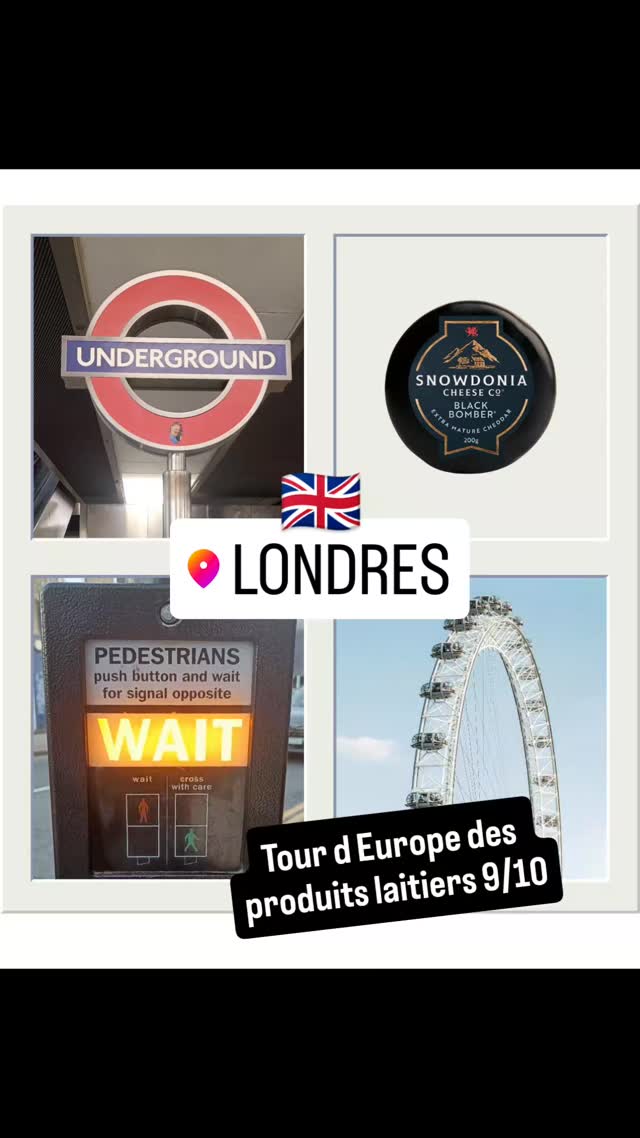
European Dairy Tour - Stage 9: London (United Kingdom) 🇬🇧
Welcome to this new series of articles where I take you across Europe to explore the dairy products, lactose-free options, and vegan alternatives available. As someone with lactose intolerance and co-founder of the lactose.help app, I decided to travel across the continent, app in hand, to give you a concrete overview of what to expect if you're travelling with an intolerance.
Ninth stop: London, United Kingdom.
The journey: the Eurostar, comfortable but disconnected
Here I am on the Eurostar Paris-London. After passport control, I'm on the train. It's very comfortable. Unfortunately, the train's internet connection is just unusable. So after a power nap, I write.
I'm expecting to find a cheese universe different from the continent. The UK also has its PDO/PGI cheeses, and I can't wait to discover them.
Quick reminder on the method
For those just joining us, lactose.help classifies products according to their maximum lactose risk, from A (very low risk, safe consumption) to E (high risk, avoid). You can check out the full methodology here.
Supermarket mission: Tesco, Sainsbury's, M&S, Waitrose & Partners
Lactose-free ranges: a limited choice
At Waitrose & Partners, I found lactose-free products from the Arla brand:
- Cream cheese
- Whole and semi-skimmed milk
- Mature Cheddar*
- Cream
*It's worth noting that this isn't really necessary: most cheddars are naturally lactose-free thanks to their ageing process.
It's worth noting that the choice of lactose-free products is much more limited than in all other countries visited, except France which remains at the bottom of the pack.
Special mention for goat's milk butter which is supposedly lactose-free.
British cheeses
Lactose concentration A (safe, maximum 0.1 g / 100 g):
- Hard Cheese Made with Butter, Smoked over Beechwood
- Godminster Organic Cheddar with Truffle
- Snowdonia Vintage Red Leicester
- Snowdonia Rock Star (Vintage Cheddar aged in Welsh slate caverns)
- Extra Mature Cheddar
- Wensleydale
- Red Fox
- Vintage White Cheddar
- Shropshire Blue Cheese
- Crumbly Wensleydale
Lactose concentration B (generally safe, maximum 0.5 g / 100 g):
- Snowdonia Extra Mature Cheddar Cheese with Black Summer Truffle
- Snowdonia Black Bomber (Extra Mature Cheddar Cheese)
- Snowdonia Beech Wood (Smoked Cheddar Cheese)
- Double Gloucester
- Lancashire
- Red Leicester
- Blue Shropshire (cow's milk)
- Blue Stilton PDO
- Highmoore
- Cheshire
- Lindum
- Mild Cheddar
- Somerset Brie
Lactose concentration C (caution, maximum 1 g / 100 g):
- Snowdonia Green Thunder (Mature Cheddar Cheese with Roasted Garlic and Herbs)
Lactose concentration D (risky, maximum 1.5 g / 100 g):
- Cheesestrings
Lactose concentration E (high risk, minimum 1.5 g / 100 g):
- Dairylea Cheese Slices
- Tesco Soft Cheese
- Seriously Original
- Primula Original Cheese
- Abergavenny Goat's Cheese
- Quark
- Cottage Cheese
- Clotted Cream
Restaurant side: vigilance is still required
At lunchtime, I go to a Vietnamese restaurant. I want to order a bánh mì, a typical Vietnamese sandwich with bread. Normally, I'm not too cautious in Asian restaurants. Here, fortunately I was careful: there was milk in the bread!
It just goes to show, you need experience to detect lactose sources. I really don't fancy being ill and stuck on the train...
Conclusion
In summary, most British cheeses are rated A and B, except for processed cheeses and fresh soft cheeses. That's really good news for the lactose intolerant!
The UK offers a cheese universe different from the continent, dominated by cheddars and their variations. The good news: the more aged a cheddar is (mature, extra mature, vintage), the safer it is for the lactose intolerant.
However, as in France, the choice of lactose-free products in supermarkets remains limited. The two Anglo-French-speaking countries seem to be lagging behind the rest of Europe on this point.
Join me tomorrow for the last stage of my European dairy tour: back to Brussels!
Have you ever travelled to the United Kingdom with lactose intolerance? Share your experiences in the comments!
None of the brands or shops mentioned are involved in any partnership. If that were the case, it would be clearly stated.
To go further
I wrote the practical guide Mieux vivre avec son intolérance au lactose: Le guide pratique pour comprendre, réintroduire et savourer les produits laitiers (Living Better with Lactose Intolerance: The Practical Guide to Understanding, Reintroducing, and Enjoying Dairy Products), available at book.lactose.help. For now, the book is only available in French, but you can vote for your language at lactose.help/book. We will translate the book based on the votes received.