
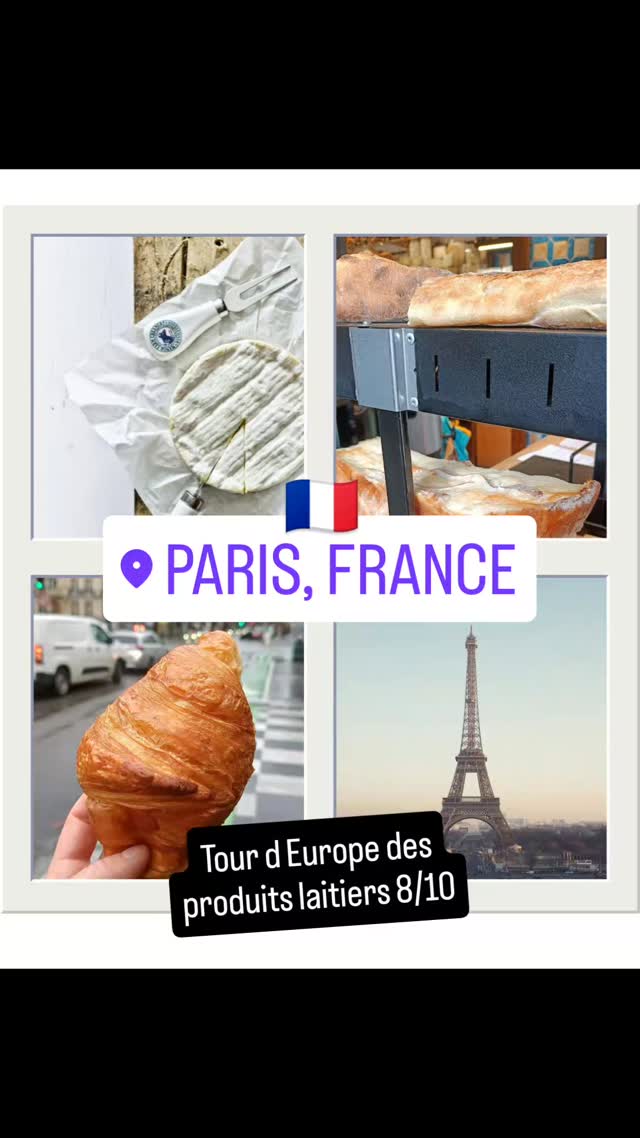
European Dairy Tour - Stage 8: Paris (France) 🇫🇷
Welcome to this new series of articles where I take you across Europe to explore the dairy products, lactose-free options, and vegan alternatives available. As someone with lactose intolerance and co-founder of the lactose.help app, I decided to travel across the continent, app in hand, to give you a concrete overview of what to expect if you're travelling with an intolerance.
Eighth stop: Paris. It's not a country and it's my second time in France, but it's not without interest: we're talking about the capital of gastronomy, an essential historical reference and birthplace of many classic culinary techniques.
Why Paris?
My goal was, in addition to the Germanic, Slavic and Roman spheres of influence, to explore the English sphere from which some cheeses reach us but not in great numbers. From Barcelona, it's difficult to go to London directly without passing through Paris.
For this stage, I focused on visiting cheese shops rather than supermarkets.
Cheese shops: a very French concept
The very concept of a cheese shop (a store that only sells cheese) is very widespread in France but not necessarily in all countries. And the funniest thing: outside France, many cheese shops are run by French people!
When looking for a cheese shop in Prague, I came across a French cheesemonger with imported cheese. In Barcelona, same observation: many cheese shops are run by French people.
The number of cheesemongers in Paris is just crazy compared to other places visited. It's a true cheese culture that doesn't exist anywhere else with such density.
Quick reminder on the method
For those just joining us, lactose.help classifies products according to their maximum lactose risk, from A (very low risk, safe consumption) to E (high risk, avoid). You can check out the full methodology here.
Parisian cheese shops: a warm welcome
I received a very warm welcome in the cheese shops I visited. Cheesemongers receive daily questions about lactose. Most answers are correct: hard paste and long ageing.
That's correct, but too restrictive as you know if you're a reader of the book.
The misconception about goat and sheep cheeses
I still hear too often: "Goat and sheep cheeses are lactose-free."
That's false! Although they're made from milk that's less concentrated in lactose than cow's milk, due to their manufacturing process, they most often contain more lactose than their cow's milk counterparts.
However, it is possible to find goat and sheep milk cheeses that are low in lactose, but you need to make sure to avoid unpleasant surprises.
Caution is therefore required.
The message to cheesemongers
The message, ultimately, is to favour quality products, which use, through their artisanal manufacturing techniques, only milk, rennet, ferments and salt. The only lactose can only come from the milk. It is therefore found in the nutritional composition of products under "of which sugars".
A lactose-intolerant person can, at minimum, digest 1 g of lactose per meal without experiencing symptoms. This 1 g threshold should pass in all cases. However, each intolerant person should carry out the lactose challenge (presented in the book) to know their own tolerance threshold and avoid unpleasant surprises.
If you recommend cheeses with a concentration not exceeding 0.5 g / 100 g, your customers would have to eat 200 g to potentially feel the effects. That leaves an appreciable margin to enjoy your products.
The lactose challenge
The lactose challenge presented in the book allows you to know your personal tolerance threshold. The principle is simple: progressively test increasing quantities of lactose to identify your limit. Be careful however: this threshold can vary depending on your level of fatigue and stress.
My dream for the lactose intolerant
My dream is that cheese shops become the preferred place for lactose-intolerant people to find quality products they can consume, based on the nutritional compositions of products to guarantee quality advice.
I find it too unfortunate that lactose-intolerant people have to deprive themselves of meals like raclette, fondue, Mont d'Or or tartiflette. If these dishes are cooked from quality products, there's no reason they shouldn't work in limited consumption (for example 200 g for a Mont d'Or).
Call to cheesemongers!
If you're a cheesemonger, know that we have a WhatsApp group for professionals, so they can ask their questions and exchange on the subject. Contact us via DM on Instagram to be added to the group.
Call to the lactose intolerant!
If you're lactose intolerant, I recommend you:
- Read the book to understand the method
- Use the lactose.help app to automate the book's method
- Follow us on social media to stay informed about the latest news from the project
Call to readers!
Tell your cheesemonger about the book! The more cheesemongers are informed, the more they can offer a choice adapted to the lactose intolerant and provide them with quality professional advice. Cheese shops are the preferred place to find artisanal products compatible with an intolerance. Let's bring the lactose intolerant back to cheese shops!
Conclusion
Paris was a different stage, focused on cheese shops rather than supermarkets. The observation is clear: cheesemongers are open to the lactose question and generally give good advice, even if they're sometimes too restrictive.
Artisanal cheese shops offer quality products, made with simple ingredients (milk, rennet, ferments, salt), which are often naturally low in lactose thanks to their ageing.
Join me tomorrow for the next stage of my European dairy tour: Barcelona!
Do you have a trusted cheese shop for your purchases? Share your good addresses in the comments!
None of the brands or shops mentioned are involved in any partnership. If that were the case, it would be clearly stated.
To go further
I wrote the practical guide Mieux vivre avec son intolérance au lactose: Le guide pratique pour comprendre, réintroduire et savourer les produits laitiers (Living Better with Lactose Intolerance: The Practical Guide to Understanding, Reintroducing, and Enjoying Dairy Products), available at book.lactose.help. For now, the book is only available in French, but you can vote for your language at lactose.help/book. We will translate the book based on the votes received.