
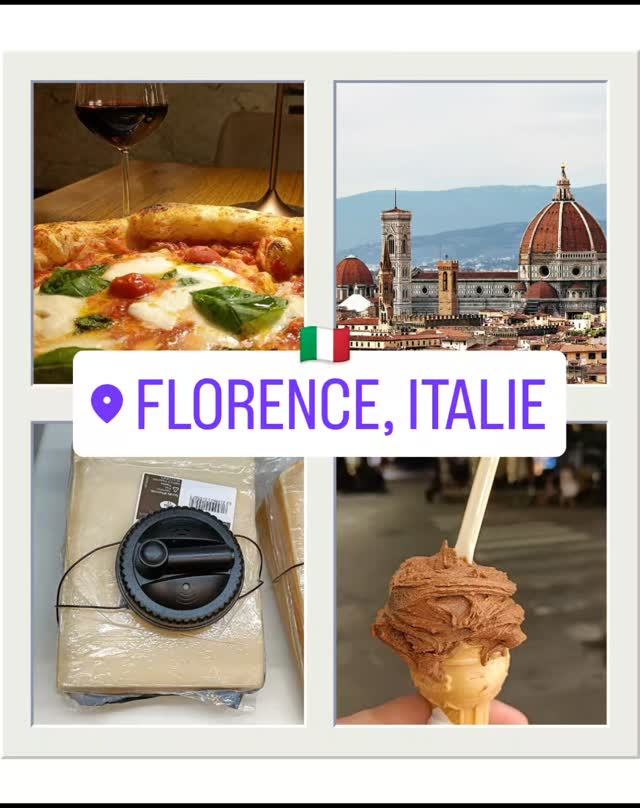
European Dairy Tour - Stop 4: Florence 🇮🇹
Welcome to this new series of articles where I take you across Europe to explore the dairy products, lactose-free options, and vegan alternatives available. As someone with lactose intolerance and co-founder of the lactose.help app, I decided to travel across the continent, app in hand, to give you a concrete overview of what to expect if you're travelling with an intolerance.
Fourth stop: Florence.
The journey: a day under pressure
Complicated journey today: two connections with little time between them. One in Cervignano, one in Venice. And my first train is already showing a 15-minute delay. I risk missing the next two and arriving too late for my supermarket operation. All I can do is hope the next train will also be delayed so I'll have made progress on my journey. The goal is to get as close as possible as quickly as possible.
So I keep one eye on the train board in Cervignano to see the platform number in advance, check for any delays, and spot the next one if I miss my connection.
I suspected when looking at the schedule that this would be the critical stage, but now it's looking like it could get funky.
I'm also offline most of the time on the train due to crossing the Alps, tunnels, and the lack of 5G. Despite the photos, I need internet to research the different cheeses and find out whether they're traditional or just a brand name.
Every day, I take approximately 100 to 200 photos of products. You only get the summary. What surprises me most is how local cheese distribution is. A large proportion of them don't really leave their production region, let alone the country. This reinforces my decision to do this European tour. There's no better way to understand a subject than to gather the information yourself.
So far, when it comes to cheese, the closer I get to the Alps, the more hard cheeses with long ageing I find, meaning no lactose.
The snow is starting to disappear and the mountains are fading into the distance. The sun is back, and so are the warmer temperatures.
A friendly encounter
I met a couple of Austrian mountain farmers. They've also taken an Interrail pass to travel down to Sicily. Super nice people. I love these conversations where I can see the world from their perspective. I can picture myself living in the mountains, able to surf whenever I want, 4-5 hours from Italy. They arrived with mountaineering gear and are going to roast doing their hikes. They only do off-piste. So cool.
Connections: phew!
I was worried the trains wouldn't connect. It came down to 5 minutes but we made it. Phew.
I just had enough time to grab a piece of focaccia with pomodori after 10 minutes of checking through a folder the size of a phone book to find the allergen information. Italian trains are top-notch, even better than the ones I've had so far.
Quick reminder on the method
For those just joining us, lactose.help classifies products according to their maximum lactose risk, from A (very low risk, safe consumption) to E (high risk, avoid). You can check out the full methodology here.
Italian PDO cheeses to find
Before leaving, I had listed the Italian PDO cheeses I wanted to try to find:
- Asiago
- Bitto
- Bra
- Burrata di Andria
- Caciocavallo Silano
- Caciottone di Norcia
- Canestrato di Moliterno
- Canestrato Pugliese
- Casatella Trevigiana
- Casciotta d'Urbino
- Castelmagno
- Fiore Sardo
- Fontina
- Formaggella del Luinese
- Formaggio di Fossa di Sogliano
- Formai de Mut dell'Alta Valle Brembana
- Gorgonzola
- Grana Padano
- Montasio
- Monte Veronese
- Mozzarella di Bufala Campana
- Mozzarella di Gioia del Colle
- Murazzano
- Nostrano Valtrompia
- Ossolano
- Parmigiano Reggiano
- Pecorino Crotonese
- Pecorino del Monte Poro
- Pecorino delle Balze Volterrane
- Pecorino di Filiano
- Pecorino di Picinisco
- Pecorino Romano
- Pecorino Sardo
- Pecorino Siciliano
- Pecorino Toscano
- Piacentinu Ennese
- Piave
- Provola dei Nebrodi
- Provolone del Monaco
- Provolone Valpadana
- Puzzone di Moena / Spretz Tzaorì
- Quartirolo Lombardo
- Ragusano
- Raschera
- Ricotta di bufala campana
- Ricotta romana
- Robiola di Roccaverano
- Salva Cremasco
- Silter
- Spressa delle Giudicarie
- Squacquerone di Romagna
- Stelvio / Stilfser
- Strachitunt
- Taleggio
- Toma Piemontese
- Piedmontese Tomme
- Valle d'Aosta Fromadzo
- Valtellina Casera
- Vastedda della valle del Belìce
Supermarket mission: Carrefour, Conad, PAM, Esselunga, Lidl
I visited several Carrefour and Conad stores, but the floor space is small in the city and the selection limited. I was surprised to see that cheeses probably packaged on-site have an ingredient list but no nutritional information on their labels. I therefore had to ignore them and stick to pre-packaged products.
This is the first time I've ever seen an anti-theft tag on cheese.
The percentage of products listed in Open Food Facts is better than in the Czech Republic and Austria overall.
Lactose-free ranges by store
At Conad/Carrefour: cream cheese, milk, yoghurt, Greek yoghurt, kefir, mascarpone, ricotta, mozzarella, butter. Impressive.
At Lidl: the section is just huge! Cream, yoghurt, butter, milk, scamorza, cream cheese, mozzarella di bufala, mozzarella, stracchino, fiocchi di latte, burrata, mascarpone.
At Esselunga: milk, butter, cream, sour cream, yoghurt, edam, caciotta, cream cheese, mozzarella di bufala, ricotta, plain and smoked scamorza, parmigiano, feta. The difference is that these aren't store brand products but come from a multitude of producers.
There's no denying it, "senza lattosio" is serious business in Italy.
Local cheeses
Mozzarella: most are rated C, with mozzarella di bufala at B.
I found a mozzarella made with fior di latte milk but fermented: Vallelata. "Fior di latte" means "flower of milk". This term emphasises the freshness and purity of the cow's milk used to make this cheese. The manufacturing process involves curdling fresh milk, removing the whey, then stretching and shaping the cheese to achieve its distinctive form. Its soft, moist texture combined with a smooth, elastic consistency makes it a prized ingredient for pizzas, caprese salads, and many other recipes. The lactose concentration is therefore B (0.2 g / 100 g). I didn't get the chance to taste it but I'll try to get some now that I know its name.
PDO cheeses: Italy has quite a collection. Since I carried out the analysis for the book, not on just a few products but on 7,000 products from 133 designations, there's no need to reinvent the wheel. Here's what I found in supermarkets:
Lactose concentration A (Safe, maximum 0.1 g / 100 g) :
- Provolone
- Asiago
- Pecorino Romano
- Parmigiano Reggiano
- Grana Padano
Lactose concentration B (Generally Safe, maximum 0.5 g / 100 g)
- Taleggio
Lactose concentration D (Risky, maximum 1.5 g / 100 g)
- Quartirolo Lombardo
I only found these out of the 59 Italian PDOs in supermarkets.
Other Italian cheeses:
Lactose concentration A (Safe, maximum 0.1 g / 100 g) :
- Scamorza, fresh or smoked (lactose concentration: A)
- Tomino del boscaiolo: a typical Italian cheese from Piedmont (lactose concentration: A)
Lactose concentration E (High Risk, minimum 1.5 g / 100 g)
- Ricotta
- Stracchino (also known as Crescenza): a fresh, soft, creamy Italian cheese made from cow's milk, typically from Lombardy
- Fiocchi di latte: similar to ricotta/cottage cheese. It's a fresh, light, creamy dairy product made in Italy
An important observation
Now, knowing that lactose-intolerant people can consume at least 1 g of lactose per meal, why deprive yourself of artisanal products rather than consuming lactose-free products that are admittedly safer but less artisanal due to lack of data?
Restaurant side
In the evening, I went on the hunt for a real Italian pizza, low in lactose of course. I had a pizza with just two types of tomatoes, mozzarella di bufala, olive oil, and basil. Even though it seems very simple, the flavour of this pizza will haunt me for years and that's just perfect. Followed by a chocolate sorbet, I can tell you I had a feast in Italy.
After my meal, I went back on the hunt for supermarkets with a local PAM, Esselunga, and Lidl. You can't say I cut corners.
Breakfast: a lesson in vigilance
After a night's sleep, I still need to find breakfast. I ask for the menu at my hotel. The person tells me there's no milk. But I'm willing to bet otherwise. She eventually pulls out some information sheets and, surprise surprise, everything was packed with milk.
Even when establishments have put everything in place to help intolerant and allergic people, that unfortunately doesn't mean it's up to date, that it's what the chef actually prepared, or that the staff are trained. Have you ever had someone go and check for an allergen and come back proudly saying: "There's no gluten", or "Watch out, there's mayonnaise" (there's no dairy in the mayonnaise recipe)? Anyway, I'll pass.
Since oil is used more than butter here, that already saves me one source of lactose. However, unsurprisingly, in sandwiches, it's hard to find a product that doesn't contain any dairy at all. It's amazing how much humans love cheese (and for good reason).
Fortunately, this being Italy, even at a train station, I was able to find a sandwich with mozzarella di bufala, dry-cured ham, and basil. Great!
For lunch, I found a sort of Subway, Italian gourmet version. So good. I take one for the train, I won't have time to buy anything before arrival, or if I do it'll be because I missed a connection.
Conclusion
While vegetarian and vegan meals are less common than in Germany or Austria, there are plenty of solutions for lactose-intolerant people.
I was very surprised to have so much choice in lactose-free products here in Italy. On the other hand, there are more lactose-intolerant people here in southern Europe than in the north. That could explain this difference.
When it comes to cheese, while in Germany, the Czech Republic, and Austria, hard cheeses reigned supreme (meaning cheeses with a lactose concentration of A for the most part, with some Bs and Es), here in Italy there's a multitude of products covering concentrations from A to E. You therefore need to be more careful when selecting products in store. With good information, it's possible to consume most products in reasonable quantities.
Don't forget that during this tour, I only examined a few products, unlike the table I produced when creating the book. So the results here cannot be extrapolated to other products with the same name. It's up to you to apply the method from the book or use the lactose.help app to get the concentration of a specific product.
Join me tomorrow for the next stage of my European dairy tour: Monthey in Switzerland, with a little surprise!
Have you ever travelled to Italy with lactose intolerance? Share your experiences in the comments!
None of the brands or shops mentioned are involved in any partnership. If that were the case, it would be clearly stated.
To go further
I wrote the practical guide Mieux vivre avec son intolérance au lactose: Le guide pratique pour comprendre, réintroduire et savourer les produits laitiers (Living Better with Lactose Intolerance: The Practical Guide to Understanding, Reintroducing, and Enjoying Dairy Products), available at book.lactose.help. For now, the book is only available in French, but you can vote for your language at lactose.help/book. We will translate the book based on the votes received.