
Lactose intolerant ? Scan Any Product, Know Instantly If It's Safe
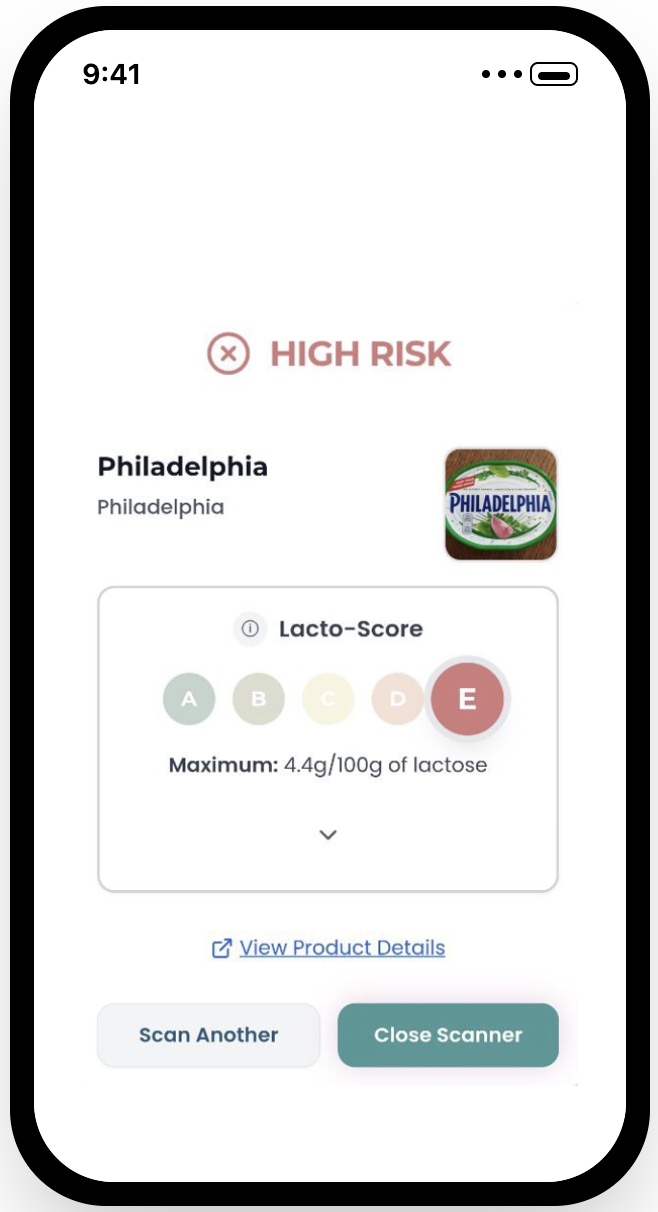
Good news: we've developed a mobile app, lactose.help, that does all the work for you. It analyses the maximum lactose concentration in a product based on its ingredient list and nutritional composition. And using it couldn't be simpler: scan the barcode, and the result appears. That's it.
Scan methodology
Understanding our technology
Our lactose detection system combines barcode recognition, image analysis, food database lookup, and advanced algorithms to determine whether a product can be safely consumed by lactose-intolerant people. All within a matter of seconds.
Lactose tolerance for an intolerant person
According to an EFSA study, lactose-intolerant people can generally consume between 6 and 12g per day, spread across three meals. The most sensitive individuals experience symptoms from as little as 3g. But a dose of 1g per meal is compatible with all forms of intolerance.
Understanding the Lacto-Score (A–E)
To make results readable at a glance, we developed the Lacto-Score. A five-level scale, inspired by the Nutri-Score, to instantly identify whether a product suits you or not.
A – Safe. 0g of lactose per 100g. Completely lactose-free, safe for everyone. B – Generally Safe. ≤0.5g of lactose per 100g. A tiny trace, perfectly tolerated in the vast majority of cases. C – Caution. ≤1g of lactose per 100g. Moderate content, to be consumed with care depending on your sensitivity. D – Risky. ≤1.5g of lactose per 100g. High lactose, likely to cause symptoms. E – High Risk. >1.5g of lactose per 100g. To be avoided if intolerant, plain and simple.
And if the product is not in our database, the app will tell you directly. A manual analysis of the ingredients is then necessary.
How our scan works
Step 1 : Barcode or photo recognition. You scan the barcode, our system identifies the product and immediately launches a search across food databases. Instant detection, product identification, ingredient information retrieval. Step 2 : Database lookup. We query several sources in parallel to retrieve the full ingredient list and nutritional information. Step 3 : If the product does not exist in the database, the app uses artificial intelligence to analyse the ingredients, detect sensitive keywords, and estimate the lactose content based on photos of the nutritional composition and ingredient list to assess the reliability score of the result. Step 4 : Viewing the result. An intuitive colour code, lactose content expressed in grams, detailed information. It's all there, clear and easy to read.
Photo analysis
When you scan a photo of a label, our AI uses optical character recognition to extract the text and analyse the ingredient list. For best results, a few simple tips: good lighting, a steady camera held close to the text, a clearly legible ingredient list, and avoid shadows and reflections. It makes all the difference.
Limitations
Results are estimates based on available data. Some products may not appear in our database. A product's composition can change without notice, vary by region, and cross-contamination risks are not always detectable.
⚠️ Important: If you have severe lactose intolerance, always check labels and consult a healthcare professional. Furthermore, this app is designed for lactose-intolerant people and is not suitable for those with a milk protein allergy.
So, curious to try it? Head over to lactose.help